
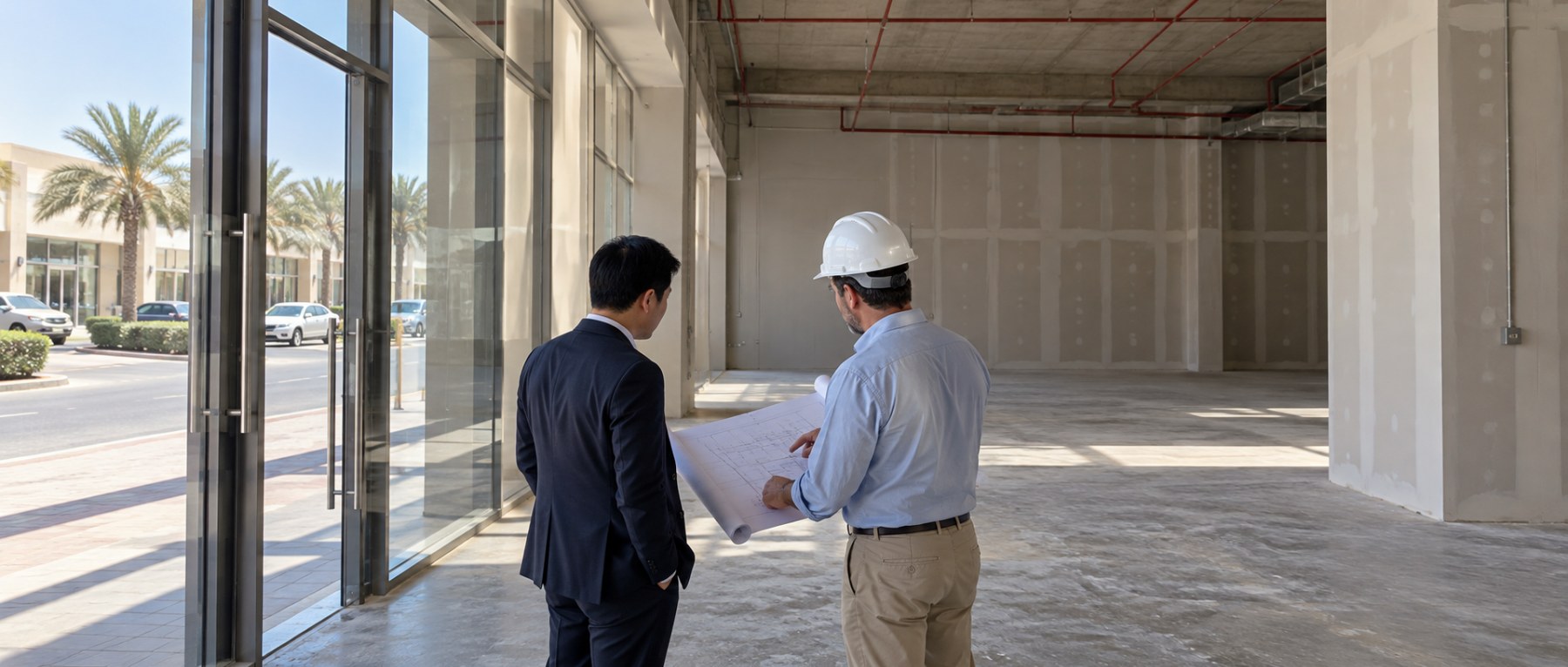
For a Chinese fit-out business preparing to take on an office or retail project in Dubai, a trade licence carrying a decoration activity is only the starting point. The company must also satisfy the registration, activity-scope and technical-staff requirements under the current legal framework for contracting activities. At project level, it must separately determine whether the job requires a Permit and Completion Certificate.
The two tracks are not interchangeable. Corporate qualification answers who may accept the work and which activities the company may perform. Project procedures determine whether this particular job may start and which document closes it. Checking only the trade licence or the owner’s consent before quoting can leave staffing gaps, application responsibility and completion documents unresolved until mobilisation.
The project procedure discussed below is limited to a Structural Unit as defined by Administrative Resolution No. (85) of 2019. It is not a general procedure for residential fit-outs, structural alterations or every project in Dubai.
How does Dubai Law No. (7) of 2025 change the contractor qualification test?
Dubai Law No. (7) of 2025 Regulating Contracting Activities establishes an emirate-wide framework for contracting activities. Its scope includes special development zones, free zones and the Dubai International Financial Centre. Statutory exceptions include contracting activities related to airports and their infrastructure and facilities, as well as any activity exempted by a decision of the Chairman of the Executive Council on the committee’s recommendation. These boundaries remain subject to the latest official publication. (Source: Government of Dubai Official Gazette, Dubai Law No. (7) of 2025 Regulating Contracting Activities, July 2025)
Under Article 5, a business may not carry on or promote itself as carrying on contracting activities unless it holds a trade licence and is entered in the contractors register. A registered contractor must remain within its authorised contracting activities and applicable classification, while technical staff carrying out the relevant work must hold the corresponding Professional Competency Certificate. These requirements remain subject to the latest official publication. (Source: Government of Dubai Official Gazette, Dubai Law No. (7) of 2025 Regulating Contracting Activities, July 2025)
A pre-contract check therefore needs to cover four separate matters: whether the trade licence remains valid, whether the entity has completed the applicable registration, whether the contract scope falls within the authorised activities and classification, and whether the proposed technical staff hold the required competency evidence. A trade licence, payment record or historical certificate cannot by itself establish that the company may currently perform the entire contract.
The law was published in the Official Gazette on 15 July 2025 and provides that it comes into force 6 months after publication. Contractors operating in Dubai when the law takes effect have 1 year from its effective date to regularise their position, and the committee may extend that period for a similar term where required. The calendar alone is not enough to conclude that the adjustment period has expired; the company should check for any subsequent decision and confirm its current registration status. These timing rules remain subject to the latest official publication. (Source: Government of Dubai Official Gazette, Dubai Law No. (7) of 2025 Regulating Contracting Activities, Articles 26 and 29, July 2025)
Can businesses still rely on the older DEQ guidance?
The older materials remain useful for understanding the publicly documented operating route, but they should not be treated as a complete current application manual.
Article 28 of Dubai Law No. (7) of 2025 keeps earlier regulations and decisions governing contracting activities in force to the extent that they do not conflict with the new law, until replacement regulations and decisions are issued. The Dubai Engineering Qualification System, or DEQ, corporate services guide, contractor FAQ and technical-staff requirements cannot simply be declared invalid. Their publication dates also matter: their screens, linked data and staffing rules should not be presented as one current route for every entity. This continuity rule remains subject to the latest official publication. (Source: Government of Dubai Official Gazette, Dubai Law No. (7) of 2025 Regulating Contracting Activities, Article 28, July 2025)
The 2022 DEQ Corporate Services Guide describes a route under which a newly established company’s transaction data could be linked from the economic licensing authority then referred to as DED to DEQ. The owner, manager or partner would then continue the process. The company dashboard could receive linked information from the economic licensing, labour, residency, Society of Engineers, Ejari and utility authorities. Data available through those links should not automatically be turned into a duplicate-upload requirement, nor does the guide establish one attachment list for every entity and activity. (Source: Dubai Municipality, DEQ Corporate Services Guide, October 2022)
The 2023 Contractor FAQ identifies different services for a new company, a foreign branch and a branch of a company from another emirate. Entity type therefore affects the route. Those service entries should not be combined into a sequence that every applicant is expected to complete. (Source: Dubai Municipality, Contractor FAQ, July 2023)
The practical approach is to use Dubai Law No. (7) of 2025 to establish the current legal framework and responsibility boundaries, while using the older DEQ materials to understand the historically published handling of company information, staff associations and certificate searches. The live service, required evidence and competent authority should then be confirmed for the entity, activity and application in question.
How should fit-out activities be matched to technical staff?

Fit-out contracts often combine design, implementation, structural, electrical and fire-safety work. An interior decoration activity does not automatically authorise every specialist element bundled into the quotation. The wider the scope, the earlier the company must identify which work it may perform and which elements require another appropriately qualified specialist.
Dubai Municipality’s February 2024 technical-staff requirements place 100051 Decoration Design & Implementation, 454009 Interior Decoration, 454013 Landscaping Works and 453004 Exhibition Stand Fitting & Execution under shared education and experience criteria. The stated options are a bachelor’s degree in Civil Engineering, Architecture or Interior Design with 1 year of experience, or a Civil Architectural Technical Diploma with 3 years of experience. (Source: Dubai Municipality, Contracting Activity and Technical Staff Requirements, February 2024)
Shared education and experience criteria do not give the activities identical scopes, staffing numbers or current registration requirements. The older DEQ guide also states that one qualified engineer may be associated with no more than two activities. The 2023 Contractor FAQ says that technical staff residency must be transferred under the contracting company’s licence; where an activity requires an examination, the engineer must meet the experience criteria before taking the relevant examination. The absence of an examination requirement does not remove the experience condition, and documents issued outside the UAE require foreign affairs attestation under that guidance. (Source: Dubai Municipality, DEQ Corporate Services Guide, October 2022; Dubai Municipality, Contractor FAQ, July 2023)
These materials help a business identify likely staffing gaps before it prices a project. They do not justify converting guidance published between 2022 and 2024 into a current universal attachment list. The applicable activity, classification, registration and Professional Competency Certificate requirements should be checked with the current competent authority under Dubai Law No. (7) of 2025.
Which projects qualify for the 100 square metre or Trade Centre exemption?
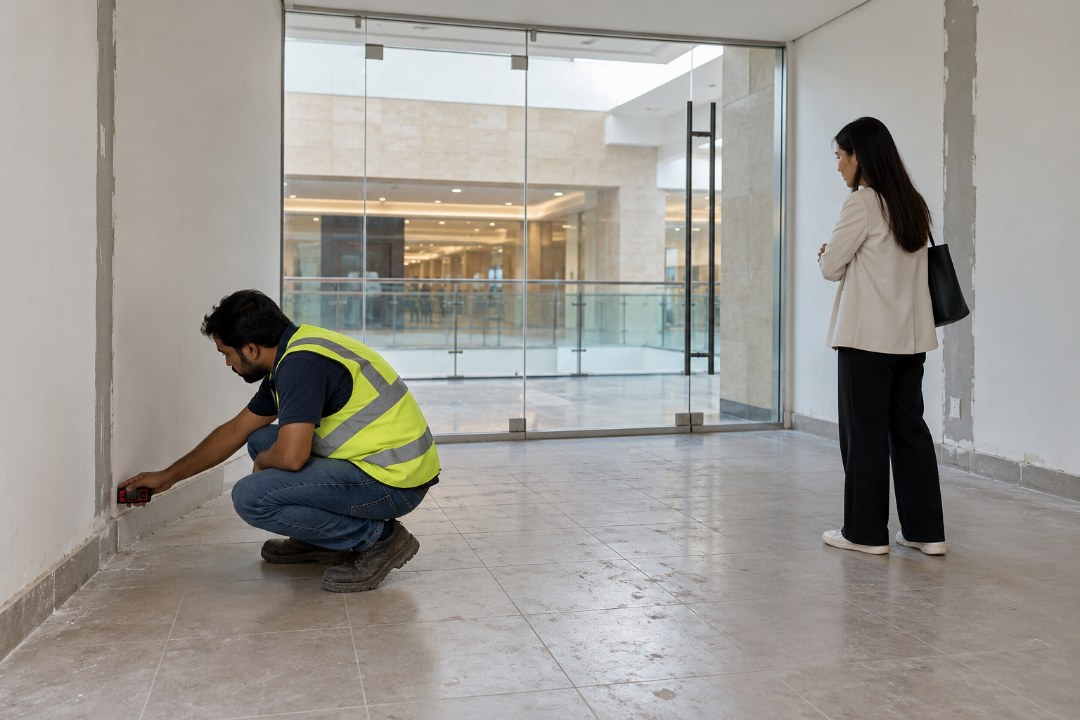
A Structural Unit under Administrative Resolution No. (85) of 2019 is an area within a building used for commercial, professional, industrial, office, consultancy or service purposes and licensed as an independent business unit. Whether the Resolution applies depends on the unit’s status, area, building type and proposed work boundaries. These requirements remain subject to the latest official publication. (Source: Dubai Legislative Portal, Administrative Resolution No. (85) of 2019, 2019)
Article 4 exempts two categories from the Permit and Completion Certificate required by this Resolution: a Structural Unit located in a Trade Centre, regardless of area, and a Structural Unit with an area not exceeding 100 square metres. In this context, Trade Centre means a commercial complex, shopping centre or similar building; it does not refer only to the Dubai World Trade Centre. These exemptions remain subject to the latest official publication. (Source: Dubai Legislative Portal, Administrative Resolution No. (85) of 2019, Articles 1 and 4, 2019)
The exemption is limited to those two project documents under this Resolution. The work must still be carried out by a Dubai Municipality-approved contractor, comply with the technical specifications and established unit boundaries, satisfy Civil Defence conditions, and have the written consent of the owner or the owner’s legal representative. Dubai Municipality retains control and audit powers. These conditions remain subject to the latest official publication. (Source: Dubai Legislative Portal, Administrative Resolution No. (85) of 2019, Articles 4–5, 2019)
A shop measuring no more than 100 square metres should therefore not be quoted or scheduled on the assumption that work may begin immediately. Contractor qualification, fire-safety conditions, written owner consent, building-management requirements and the actual work boundaries still need to be resolved. Work that adds, removes, merges or separates built-up areas should not be placed directly into this fit-out procedure. Requirements imposed by another competent authority, a zone or a specialist workstream must be addressed separately.
Who applies for a non-exempt project, and what proves that work may start?
A project that meets the Structural Unit definition, exceeds 100 square metres and does not fall within the Trade Centre exemption must obtain the Permit required by Administrative Resolution No. (85) of 2019 before fit-out work starts. The applicant is a Dubai Municipality-approved contractor, which submits the application and fit-out plans through the decoration works Permit self-service in the Dubai Building Permit System. The owner or a Chinese parent company cannot replace the approved contractor as the applicant. These requirements remain subject to the latest official publication. (Source: Dubai Legislative Portal, Administrative Resolution No. (85) of 2019, Article 2, 2019)
The system submission and the substantive project conditions should be kept distinct. The Resolution expressly identifies the application and fit-out plans as submission content. It also requires the owner’s or legal representative’s written consent, compliance with Civil Defence conditions and technical specifications, observance of the unit boundaries in the approved plans, and payment of the prescribed fees. Without a current service-list basis, these conditions should not be expanded into separate NOCs or mandatory system attachments. These requirements remain subject to the latest official publication. (Source: Dubai Legislative Portal, Administrative Resolution No. (85) of 2019, Article 2, 2019)
The Permit is the evidence required before work begins under this Resolution. After completion, the contractor obtains the Completion Certificate through the system. The self-service mechanism does not require separate Dubai Municipality approval of the fit-out plans or Completion Certificate, but it does not remove the substantive requirements concerning drawings, fire safety, unit boundaries or technical specifications. These rules remain subject to the latest official publication. (Source: Dubai Legislative Portal, Administrative Resolution No. (85) of 2019, Articles 2–3, 2019)
How should both dependency chains be reflected in the quotation and contract?
On the company side, confirm the trade-licence activities covering the proposed scope, the applicable registration and classification, the technical-staff configuration and Professional Competency Certificates, and the company’s current professional practice status. A historical DEQ certificate may help locate the record, but it does not replace confirmation of the current registration and authorised activities.
On the project side, establish the unit’s status as an independently licensed business unit, its area, building type and proposed work boundaries. Allocate responsibility for the contractor’s submission, fit-out plans, written owner consent, applicable fire-safety conditions and any building-management requirements. For a non-exempt project, the Permit should be a condition to mobilisation and the Completion Certificate should form part of the handover obligation.
The contract should assign design, specialist works, permit applications, fees and completion documents separately. A company without confirmed qualification should not promise a start date merely because its trade licence is being processed. A project with unsettled boundaries should not be promised an exemption merely because of its area or location in a shopping centre.
Before signing the contract or committing to a mobilisation date, businesses that need to align their Dubai entity, technical staff and commercial fit-out scope can Schedule a 30-minute complimentary assessment. Confirm what the company may undertake first, then confirm which documents allow this particular project to start and close.
Last updated: October 2026. This content is for informational purposes only and does not constitute legal or tax advice. Contractor registration, project permits and competent-authority requirements may change; refer to the latest official publication. For professional consultation, please contact the MIRISE team.